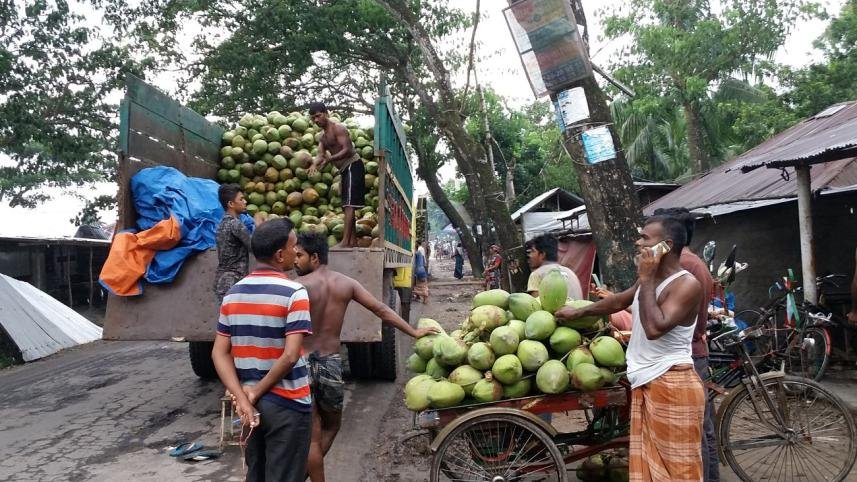
Service modelMechanised coconut-tree access and harvesting; indicative of the service capability proposed for Coconut Coast.
First phaseGrow. Care. Harvest. Sell.24 months · verify sites, service economics and buyer routes before release
5,000 farmers10,000 saplings130 rural service entrepreneurs
Current context
Coconut farming is changing in Bagerhat
Bagerhat producers face pest pressure while green-coconut trading is changing market choices. Coconut Coast links planting, tree care, paid climbing services and market development.
Nursery allocation, farmer selection and the site plan require field validation.
Tree careTree access can support inspection, maintenance and harvest services.
Existing trees
Existing trees need attention too
Current Bagerhat reporting shows pest pressure on existing trees. Coconut Coast proposes mechanised access, agronomic support and local maintenance as one local service.
125proposed climbing-service operators
Farm + service cycle
Grow. Care. Harvest. Sell.
Grow
Build nursery capacity, establish new planting and support cultivation and pest management.
5,000 farmers10 nurseries10,000 saplings
Care
Make inspection, maintenance and pest-management routines available through locally maintainable tree-access services.
125 proposed service operatorsTree access · pest management · maintenance
Harvest
Train operators to provide paid climbing and harvest services, then track service use rather than equipment distribution alone.
125 climbing operators5 processing operatorsServices used · service revenue · production handled
Sell
Prioritise fresh-market routes, adding mature coconut or processing only where buyer demand and economics are verified.
Fresh marketMature coconutProcessing where viable
Market contextBagerhat · external reporting, not project delivery evidence.
First operating phase
Where your funding goes
Planting
Build the productive base
Nurseries and planting material
Farmer cultivation and field support
EnvironmentLivelihood
Tree services
Build local service capability
Mechanised tree-service equipment
Operator training, safety and local maintenance
EducationHealthLivelihood
Market access
Strengthen the route to market
Selective processing where viable
Buyer development and market routes
Livelihood
Across the first phaseVerification · procurement · programme delivery · measurement · reportingFinal costing follows scope verification.
Funding stewardship
Controls on the first phase
Funding is released against verified sites, delivery readiness and measurable operating evidence.
Delivery roles
Cultivera integrates delivery; SAF Bangladesh is the proposed field implementer, with field roles scoped before launch.
Release conditions
Sites, farmer register, costs, procurement, operator safety and measurement ownership are confirmed before funds move.
Operating evidence
Track saplings established, services used, production sold, service revenue and repeat buyers.
Exceptions + reporting
Safety, maintenance, cost and buyer-route gaps are logged before any scale decision.
Planning scenario
Shape the programme mix
Start from Cultivera’s reference mix, then adjust Environment, Health, Education and Livelihood to test how a different priority reshapes the first phase.
100%programme allocation · always balanced
Cultivera allocation
Cultivera baseline remains the recommended first-phase mix.
Programme emphasisEnvironment
Nurseries, planting material and resilient cultivation.
35%Cultivera baseline
10 nursery places9,975 planning saplings
Programme emphasisHealth
Safer tree care and operator protection.
15%Cultivera baseline
3,000 safe-service placesOperator safety and referral protocol
Programme emphasisEducation
Climbing, maintenance and enterprise skills.
20%Cultivera baseline
100 operator-training placesCare, access and equipment practice
Programme emphasisLivelihood
Paid services, buyer routes and recorded settlement.
30%Cultivera baseline
3 buyer routes under verification120 service-enterprise places
Open for funding · Bagerhat
First operating phase
5,000 farmers10,000 saplings130 rural service entrepreneurs24 months