Orange cosmos flowers moving in the breeze against a clear sky

Concept Evidence programme

Gadkhali–Jhikargachha · Jashore

The Flower Clock.

Measure harvest-to-acceptance time across the Gadkhali flower route before cold-chain capacity is chosen.

Crop Intelligence · Flowers · 2024–25

Jashore holds 92.7% of recorded flower production.

The governed district record makes Jashore the place to test the route. It does not tell us which cold-chain intervention the corridor needs.

Open Flowers in Crop Intelligence →
Bangladesh district flower atlas with Jashore highlightedJashore is highlighted within the Bangladesh district atlas because it accounts for 92.7 percent of recorded 2024–25 district flower production in the governed Crop Intelligence dataset.
Flowers · recorded district productionBangladesh · 64 districts
92.7%of recorded 64-district flower production
Production share92.7%
Area share47.5%
33,341 trecorded Jashore production
588 harecorded Jashore flower area

Production share and area share are separate measures. No yield claim is made.

BBS Yearbook of Agricultural Statistics 2025 · governed 2024–25 district flower components.

Field visitors discussing an organised flower nursery in Bogra, Bangladesh
Context image · floriculture, BograNot project evidence
The evidence gap

We know where to look. Losses are unmeasured.

Production concentration tells us where to look. FRiO must still measure load, time, handling, treatment, buyer response and existing capacity before permanent equipment is specified.

Load
What volume moves, when, and in what mix?
Time
Where does condition begin to change?
Control
Which handling or treatment preserves acceptance?
Existing capacity
What can already serve the route?

Reported market pattern 2025 reporting describes growers arriving before dawn and wholesale trade concentrated in the early morning, with activity reported through around 9am. FRiO will measure the actual corridor clock.

Harvest to buyer acceptance

Follow one load.

Follow the same load from harvest through buyer acceptance. Choose a handoff to see what FRiO records before the investment decision.

Representative flower harvesting and handling
01/ 06
01 · Harvest window

Starting condition and harvest time

Record species, maturity, condition and harvest timing.

Risk
Over-maturity, field heat, water stress and mixed quality
Test
Harvest window, shade, clean cutting and immediate handling
Decision
Define the acceptable starting condition.
Evidence to record
RecordSpecies, maturity, starting temperature, stem condition and harvest time
Existing capacityCutting tools, shade, clean water and field handling practices

Stage 1 of 6: Harvest
Proposed measurement programme

Repeat the run across demand periods.

Continue until condition change and buyer response are consistent enough to support a decision.

01Gadkhali farmsHarvest02AggregationLoad formation03Treatment pointProportionate control04DispatchNamed buyer window05BuyerAcceptance + settlement
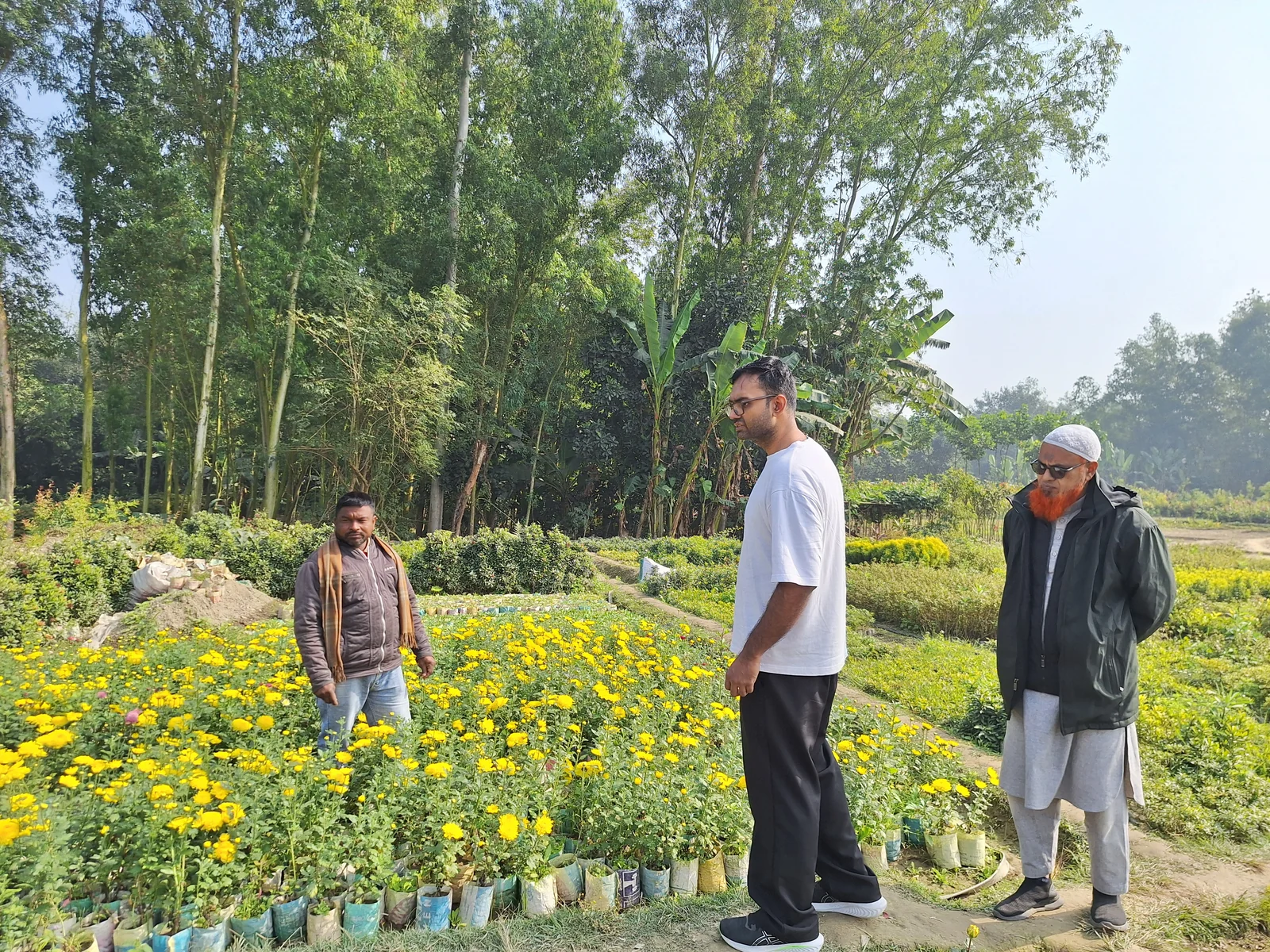
Field team members discussing nursery operations among flowering plants in Bogra, Bangladesh
Context image · field discussion, BograNot project evidence
Proposed repeated study design
Product + market mix

Test more than one flower type across different demand periods.

Load + movement states

Record smaller, typical and peak movement once field volumes establish the classes.

Current + controlled movement

Compare current practice with handling-led and, where justified, active treatment.

Buyer closure

Join acceptance, rejection, price and settlement to each route record.

One route recordKeep harvest time, handling, dwell, arrival condition, acceptance and settlement on the same load.
01Starting at harvest

Flower type, maturity, quantity, harvest time and starting condition.

02What changed before dispatch

Grading, hydration, shade, packing, treatment and time spent at each step.

03How long it waited and moved

Holding time, temperature, loading, journey time and transfer events.

04What the buyer accepted and paid

Accepted and rejected stems, reason, price, deductions and settlement time.

Commission the evidence programme

What the study must establish.

A decision package that links route condition to buyer response before any permanent cold-chain specification is released.

06 stages

Flower Clock record

Harvest through buyer acceptance measured as one commercial journey.

01 dataset

Buyer acceptance

Condition, rejection, price, deductions and settlement joined to route time.

01 audit

Existing capacity

Function, access and route fit of current handling and cooling assets.

01 mandate

Investment decision

Choose the least infrastructure-intensive response that the evidence supports.

Programme scope

Four commissioning workstreams.

Cost shares follow after sites, repeat runs and measurement needs are confirmed.

01Corridor measurementRepeated harvest-to-buyer runs across demand periods
02Handling + treatmentCurrent practice, handling-led control and justified treatment trials
03Buyer + unit economicsAcceptance, rejection, price and cost per accepted stem
04Asset audit + mandateUse what works before specifying new capital
The decision

Build only what the Flower Clock proves.

The commission ends with a route decision. Permanent equipment follows only where the evidence supports it.

01 · Use what works

Handling-led

Prioritise existing assets and operating controls when they preserve route condition.

02 · Test added control

Pilot

Pilot treatment or corridor capacity only where buyer acceptance and unit economics improve enough to justify the added cost.

03 · Stop capital

No build yet

Do not specify permanent equipment when repeated buyer response and unit economics do not support it.

Current askCommission the repeated Flower Clock measurement study.Funding for permanent cold-chain infrastructure is not currently sought.
Discuss the FRiO study
Evidence notes

Governed district evidence: Jashore records 33,340.68 tonnes of flower production and 587.668302 hectares of flower area in the governed 2024–25 district flower components. Public display rounds these to 33,341 t and 588 ha. Jashore accounts for 92.7% of recorded district production and 47.5% of recorded district flower area. No yield claim is made.

Reported sector context: 2025 reporting places core Gadkhali and nearby cultivation at roughly 637 to 650 hectares, depending on source and geography. These reports provide context rather than FRiO project evidence.

Market timing: 2025 reporting describes growers arriving before dawn and wholesale trading concentrated in the early morning, with activity reported through around 9am. FRiO must measure route timing directly.

Existing assets: Government and sector records refer to a Godkhali Flower Market Centre Complex, collection infrastructure and cold-storage capacity. FRiO will verify function, access and route fit.

Technical precedent: A 2025 open-access BAU trial reported a two-ton hybrid horticultural cooler operating near 10.2°C and averaging about 6.79 kWh per day during the trial. It tested fruits and vegetables and does not provide FRiO design assumptions.